
Flashcards: Tips & How-to
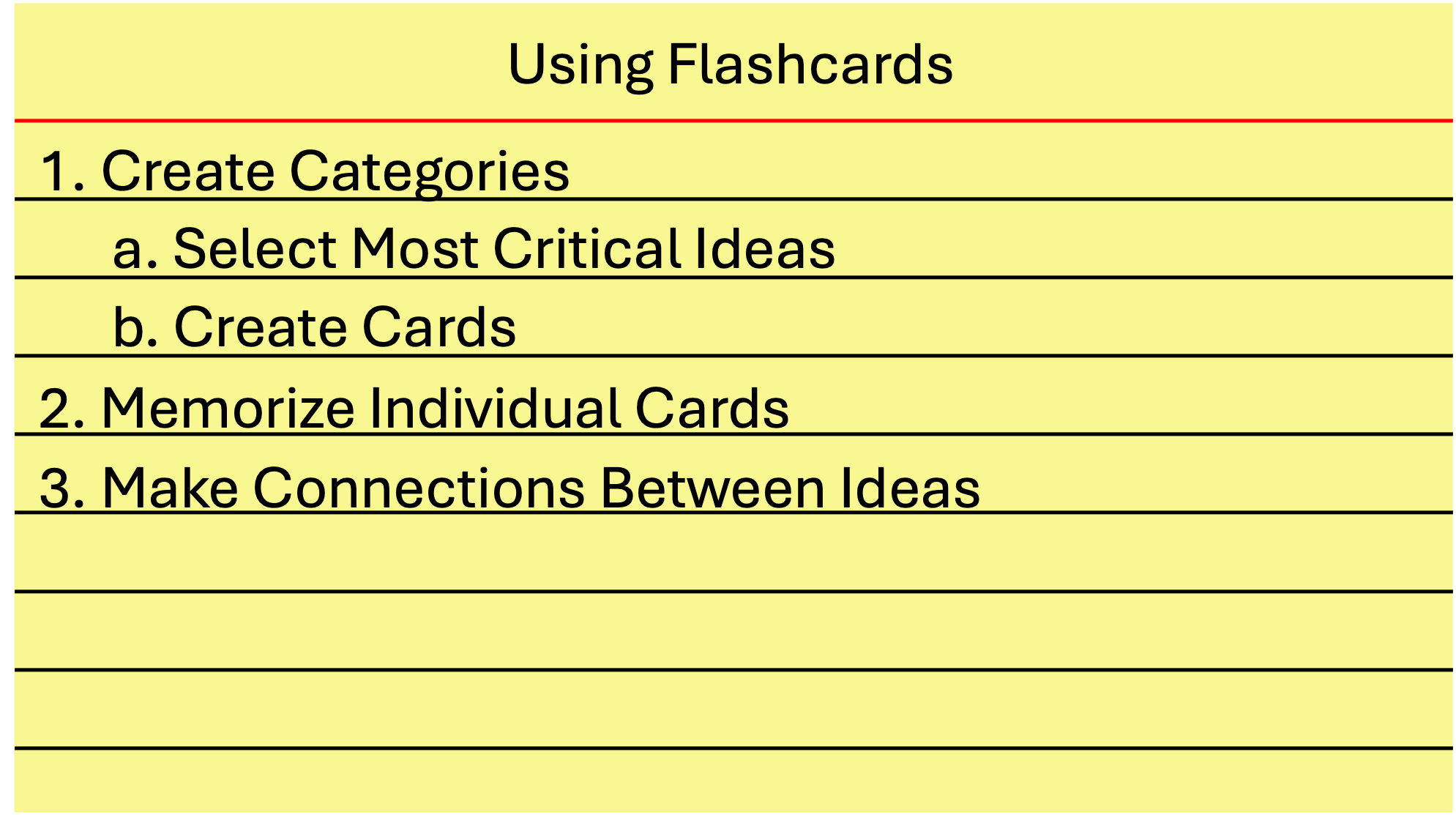
It is important to use the flashcards multiple times. Just like the first time you review any relatively new information, the first time you use the flashcards may be a bit overwhelming or frustrating because of the “forgetting” that has occurred. Here’s the good news: with repetition, you will remember more and more, therefore forgetting less and less.
While there is some value to remembering key terms and other information, it’s important to remember that in college there is far less memorization than in high school, as learners need to be able to apply and make meaning of information.
Below are the steps to create your flashcards, along with approaches to test memory and make meaning of the information as you go along.
1. Making Flashcards
- Choose the category of information for your “deck” of flashcards. Instead of turning every piece of information from the class into a card, consider making a deck of related terms, facts, or formulas.
- Select the most important information within that category. This can be a great opportunity to predict which information will likely be on the exam, and think about what are the most critical ideas. Often there are hints about this, such as bolded terms in the textbook or concepts that your professor emphasized or repeated in class.
2. Memorizing Individual Cards
- Look at the prompt on the first card, and explain the related information listed on the back without peeking. Try to say the information out loud, and then flip over the card to see if you were correct and thorough.
- If correct, move the card to a separate pile. Make sure not to fool yourself by peeking when you get stuck. It’s common to be stuck, peek, and tell yourself, “Oh yeah, I knew that.” If you could not remember without looking, you did not know it!
- If not correct, revisit again at the end of your study session. This helps you to spend more time with what you remember the least.
- Revisit each stack as often as your time allows. The more “swipes,” the more it will become “memorized.”
3. Making Meaning
- Ask yourself questions about individual cards. Once you can remember the information on the back associated with the prompt on the front, raise questions such as, “What else is this related to?” “Why is this important?” “How would I apply this information?”
- Create a mindmap with the cards. Explain all the connections you see between individual cards and between groups of cards.
- Use flashcards in groups. Get together with peers from class during a planned study session, and test each other using the cards. You can even tackle the flashcard making process as a group, discussing which concepts you think are “flashcard worthy,” and why. You can even make a game of using flashcards in a group, such as a Jeopardy-style contest.